Beyond the Boundaries of Reality
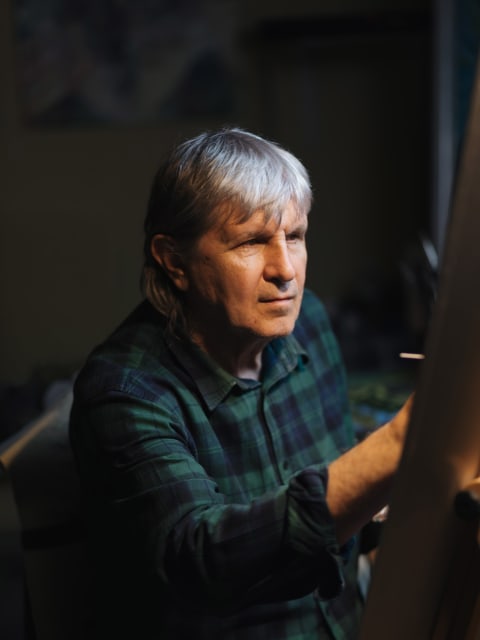
I stepped onto the stage of the world on September 5, 1964, in a dusty little town called Nagyszőlős (Vynohradiv), in the “mystical” shadow of Black Mountain. The precious moments of my childhood were born in my grandfather's house, where he introduced me not only to paints but also to stories created by his own imagination.
Within the walls of school, I was withdrawn, closed off like a prison door, and art was the key. On my journey to discover different styles and artists, after learning about the works of Da Vinci and Michelangelo, I finally anchored in the surrealist realm of Salvador Dalí. As I neared the end of my high school years, my spirit broke free from the bottle, giving form and color to the unspeakable.
My mentor, painter Miklós Papp, helped me a lot, teaching me about worldviews, artistic movements, and techniques. Soon I had the opportunity to exhibit some of my paintings with local artists, but the audience, bound by the shackles of reality, received the world of my dreams projected onto canvas with suspicion.
I continued my studies at the Nagyszőlős Polytechnic, and in the spring of 1983, I had to go to Moldova for an internship. On the farewell night, my friends and I painted dreams on the city walls with spray paint — I had no idea these images would echo more strongly than my brushstrokes. News reached me in Moldova: the KGB was looking for the creator of the murals. Returning home, I had to face the regime, which feared my graffiti more than my artistic works. They harassed my friends and my uncle, who was a political prisoner in '56. After interrogations, they decided that the army might drive the demon of art out of me. My adolescence ended here.
With the help of the KGB and party members, I was expelled from the Komsomol (which didn't really sadden me). On December 5, I was sent off to military service and told to write about my first (and hopefully last) encounter with polar bears. At the Perm railway station, I awoke to harsh reality among one-and-a-half-meter snow walls. Beyond the city of Solikamsk in northern Ural, near the Komi ASSR, I ended up in a small village where there were more prisoners than free people. The village was surrounded by forest and swamp — passable only when nature allowed.
A tough period lay ahead. Bad news came from home: my father was fired because of me. My mother was threatened with the same. Locally, according to the cruel justice of the older soldiers, “it’s cold for three months, then very cold for nine.” By a twist of fate, in the barracks' boiler house, a prisoner convicted of multiple murders painted posters for the regime and freedom for himself. In the evenings, when I could, I snuck out to him. We drank hot chifir tea and painted together as newfound friends.
Christmas 1985 brought my release. It was a long road out of hell. I made it home for Christmas and could finally hug my mother, father, and sister. I threw myself into adult life. There were new friendships, love, experiences, memories at the Tisza quarry lake, then the BIG love — I got married, had two sons, but hard years returned, and I struggled to make a living. The four of us lived in a small room, where I could only paint on the floor if I had the time and strength.
My paintings were praised, but within the cold walls of reality, they found no home.
Now, decades later, I have picked up the brush again. I still have thoughts that demand form, colors that yearn for light. Surrealism is not just an artistic style for me — it is the only reality where I can truly be free.
“I was closed off like a prison door, and art was the key.”